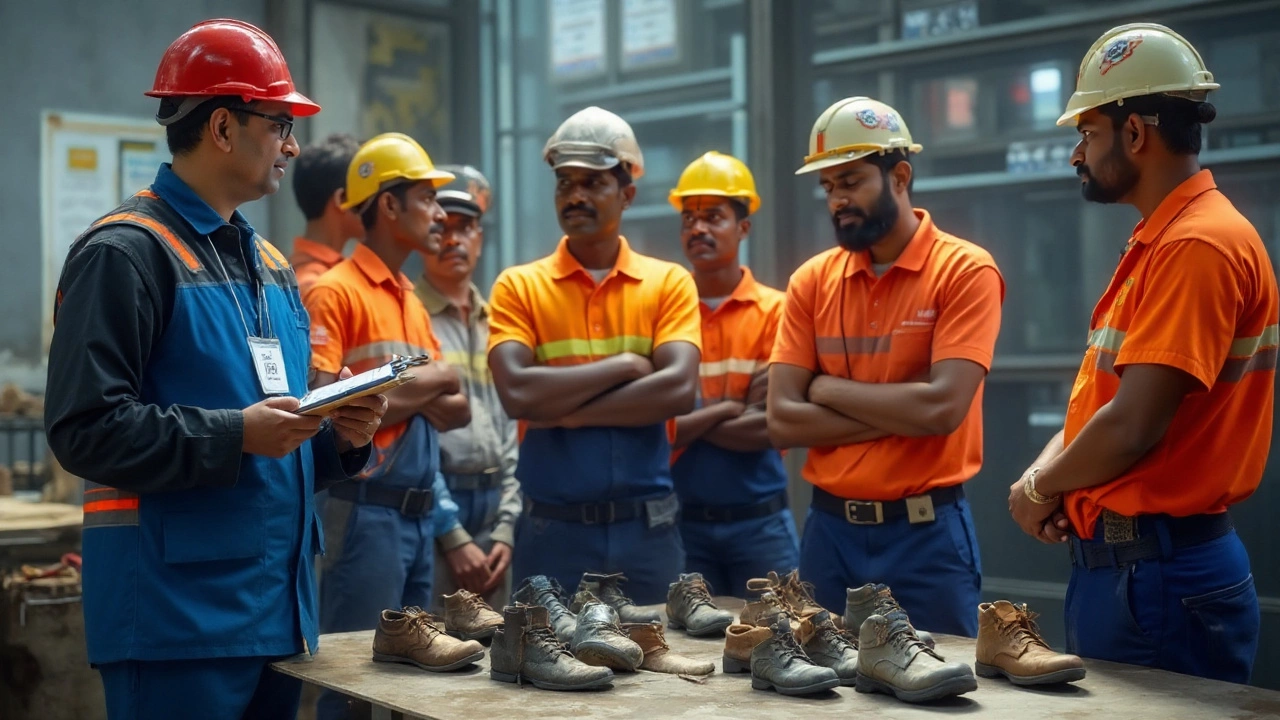
Employer Pay for Safety Shoes: Who Covers the Cost and What You Need to Know
When it comes to employer pay for safety shoes, the legal requirement in many countries, including India, is that employers must provide and pay for protective footwear when it’s necessary for job safety. This isn’t a perk—it’s a responsibility under workplace safety laws. Also known as personal protective equipment (PPE) costs, this rule exists because unsafe footwear leads to slips, crushes, electrical shocks, and long-term injuries that cost more than the shoes themselves. If your job involves construction, manufacturing, warehousing, or even kitchen work, your employer can’t make you buy your own safety shoes if they’re required for the role.
Not all shoes count as safety footwear. A safety shoe, is a type of protective footwear with reinforced toes, slip-resistant soles, or electrical hazard protection. It’s not just a sturdy boot—it’s engineered to meet specific safety standards like IS 15298 in India or ASTM F2413 in the U.S. Workplace safety regulations often list exact requirements: steel toes for heavy lifting, non-conductive soles for electricians, puncture-resistant soles for warehouse staff. If your job exposes you to any of these risks, your employer must supply the right shoes—or pay you for them. Some companies try to cut corners by saying "you can wear your own," but if the shoes are mandatory, the cost falls on them. There’s no gray area: if the footwear is required to comply with safety rules, it’s the employer’s expense.
What about replacements? If your safety shoes wear out after six months of daily use, your employer must replace them. They can’t make you pay for normal wear and tear. Same goes for damaged shoes—if you drop a tool on your toes and the toe cap cracks, that’s not your fault. You’re not expected to fix your own protection. And if your employer gives you a stipend instead of actual shoes, it must cover the full cost of a certified pair, not just a basic discount model.
You’ll find plenty of posts here that dig into the details: what qualifies as safety footwear, how to spot a real certified pair, how to handle disputes with your employer, and even how to choose the most comfortable safety shoe that still meets standards. Some articles compare materials like leather versus composite toes. Others explain how safety standards differ between industries. There’s even a guide on how to talk to your manager if they’re refusing to pay. This isn’t about fashion—it’s about walking home safe every day. And if your employer won’t foot the bill for the right shoes, you have rights. Let’s get clear on what those are.